Plain weave
The simplest weave, with warp and weft crossing one over, one under. Thin and crisp, it looks the same on both sides.


Woven labels are made with especially fine yarns, woven at high density within a small area. There are several ways to weave them, called weave structures, and each one creates a different look.
We suggest the best weave for your design and needs.

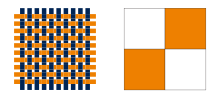
The simplest weave, with warp and weft crossing one over, one under. Thin and crisp, it looks the same on both sides.


More warp shows on the face, in 5-, 8-, 10- or 12-end variations. A soft hand with a gentle sheen. The back is a sateen weave.


The back side of satin. More weft shows on the face, with less sheen, so the weft colors come through more strongly.


The yarn crossings form diagonal lines. The angle of the twill changes with the number of warp and weft yarns.


A weave with horizontal ribs on the surface. For labels, the weft is finer than in standard grosgrain, so the structure is made differently.


A variation of plain weave, woven with 2–4 yarns together for a clear, basket-like texture.

Ordinary weaves have about 30–40 picks per cm; high-density weaves have about 50–80. Small text and complex designs come out sharply.
Materials matter as much as the weave. Different yarns and combinations open up richer expression.
On our shuttle looms, we weave soft 100% cotton and rayon labels with a warm, vintage feel.
We are also introducing recycled materials with care for the environment. If you have a material in mind, just ask.


Finishing is usually chosen to suit how the label will be used.
Besides the options below, we can make custom finishes to your request.


Both ends are folded under, so no cut edges show. Used on shirts, blouses and much more.


Both ends are folded at an angle. Sewn at the collar, it doubles as a hanging loop and adds an accent.


An end-folded label folded again in the center. The cut edges stay hidden for a premium finish.


The label is folded in three. Handy for attaching after the garment is sewn, with the cut edges neatly hidden.


The label is folded in half and sewn into a seam, such as a collar or side seam. Popular for pouches, bags and handkerchiefs.


Heat-cut with no folding. Usually sewn on all four sides.